Monday, November 13, 2006

Getting Bigger

It is estimated that on October 17 of this year, the population of the United States reached 300 million people. That's a lot of people, but our country is geographically big enough that it still makes us only the 172nd most dense country in the world, which is also less dense than the world is.

Still though, it begs the question, where do all these people live? Now we can see:


Tuesday, November 07, 2006

On being a single-issue voter

John Piper says,

Being a single-issue [voter] does not mean that only one issue matters. It means that some issues may matter enough to [disqualify someone].
For him, being a one issue voter is not an issue. And so it is in my political views. As we watch returns come in on this election eve, I thought it was worth reflecting on my own political viewpoints.

There is no doubt that one issue is by far most important to me when it comes to my personal political position. Abortion. Since 1973, when Roe vs. Wade was decided in our country, 47,282,923 abortions have occurred. Currently, approximately 1.3 million lives are ended via abortion each year in our country. Any issue that costs lives is extremely important. However, when it's an issue that literally is costing millions and millions of lives, it is of utmost vital importance. Can you imagine our country with almost 50 million more children over the last three decades filled with the potential to do great things?

Globally, it is estimated that 1,225,000 abortions occur each month. In about the last 75 years, it is estimated that 945,000,000 total abortions have occurred globally. So in less than four years, we will have reached the point when more than a BILLION babies have been killed on our planet. No other issue comes even close to affecting the same number of lives. It is the genocide of our age, and ending it is the single most important issue facing us today.

With that understood, it is difficult to cast a ballot for any candidate who does not endorse ending this travesty in our country no matter the other issues. This one issue is my litmus test. That being said, I am not beholden to any one party or ignoring other issues. If good candidates who are pro-life run, I will seriously consider their credentials. I cannot in good faith consider pro-abortion candidates in the same way.

It is, therefore, pretty straightforward for me. I, being pro-life, look at the candidates before me and vote for the pro-life candidate. If they both are pro-life, other very important issues such as global poverty and hunger, fair wages, Third World corruption, Darfur, earthly stewardship, and fiscal responsibility must be examined. But for this era, so long as pro-abortion policies continue, I will remain a single-issue voter.

Thursday, November 02, 2006

The End of an Era

I remember waking up each morning I stayed at my Grandma's house (as we didn't have our own TV) in the summers and watching The Price Is Right with my siblings. It was a tradition that brings back fond memories. Now the show will be different.

This coming summer, the longtime host of The Price Is Right, Bob Barker, is retiring. He has hosted the show since September 4, 1972, making it the longest-running daytime game show in television history.

Will the show seem the same without Bob?

Friday, October 27, 2006

Tuesday, October 24, 2006

Does TV cause autism?

Among the diseases that have increased in the last few decades, autism is one of the most commonly mentioned.
The alarming rise in autism rates in the U.S. and some other developed nations is one of the most anguishing mysteries of modern medicine — and the source of much desperate speculation by parents. In 1970, its incidence was thought to be just 1 in 2,500; today about 1 in 170 kids born in the U.S. fall somewhere on the autism spectrum.
The problem is, nobody can say for sure what has caused that increase. Some say that it is the mercury-based preservative in vaccines and others say it has only increased due to broader definitions and better detection, not actual incidence.

Now, however, a study has been released that seems to show a correlation between TV watching prior to age 3 and autism. Causation seems to be a little trickier to nail down, but the study is certainly intriguing. The hypothesis does seem to make sense. Gregg Easterbrook pondered approximately a month ago (prior to the study's release),
The autism rise began around 1980, about the same time cable television and VCRs became common, allowing children to watch television aimed at them any time. Since the brain is organizing during the first years of life and since human beings evolved responding to three-dimensional stimuli, I wondered if exposing toddlers to lots of colorful two-dimensional stimulation could be harmful to brain development.
Now, he notes,

Cornell University researchers are reporting what appears to be a statistically significant relationship between autism rates and television watching...The Cornell study represents a potential bombshell in the autism debate.
Needless to say, not all reaction to the study has been positive. Further research will tell whether a new piece of evidence has indeed been found in puzzling together the mystery of autism.

But could our proclivity to babysit via video be damaging our children? It is worth wondering.

Monday, October 23, 2006

Hot Zones

I thought this was interesting. Planners here in Chicago have used special satellite images to show which Chicago neighborhoods are the hottest. Literally, the hottest. Urban areas create a 'heat island' effect due to the black tar roofs and asphalt parking lots abundant in the city, which release hot blasts back into the surrounding environment. Vegetation, on the other hand, holds down temps by creating shade and evaporating water.

As it turns out, the study shows that tree cover is linked to lower temps, which makes sense. Those areas with the fewest trees and vegetation also were the most likely to exhibit the 'heat island' effect. The treeless (and hotter) areas were mapped and identified.

Using this, the planners are able to plan tree planting and development of vegetation-covered 'green roofs,' hopefully alleviating some of the heat in these neighborhoods. Pretty cool, I thought.

Sunday, October 22, 2006

A Wild Finish in the Chicago Marathon

Whoah, talk about a wild finish to a marathon! Today's winner, Robert Cheruiyot slipped and fell backwards, landing flat on his back and hitting his head, as he crossed the finish line. I was watching the race live as it happened (see video here), and he literally slipped under the finish banner, never touching it. Cheruiyot had just finished holding off Daniel Njenga in a push to the finish, but for a moment there was question as to whether he had officially crossed the finish line. He was ruled the winner, however, as most of his body crossed the line as he slipped. Said official race referee, Pat Savage,
He just slipped. Luckily for him, he slipped...forward. The finish line is right at the beginning of the mat, and he ended up sliding right across it. ... There is no doubt about it; he's the winner.
Undoubtedly feeling somewhat better because he is the winner, Cheruiyot is recovering overnight at a local hospital after suffering some external and internal bleeding in his head.

How ironic that he had just successfully won a 26.2 mile race only to be felled by the finish line.

Saturday, October 21, 2006

Celebrity Adoptions

Last week, Madonna caused quite a stir by swooping into Africa and choosing a little boy from an orphanage for adoption. She was criticized because she sidestepped certain rules in order to make the adoption happen quickly. The question is, who benefits from celebrity adoptions? Does the child? Or does the celebrity just gain positive press? Often these children will end up in situations entirely different than what their home was.

CNN asks,
A mother or a motherland?
What a choice to make: a heritage or a home. African orphans need and want parents. Well-known White Americans -- Angelina Jolie and Madonna -- are looking to adopt. But the way those celebrities are adding to their families raises an interesting question: Is it OK for white families to raise African children? And if it is, at what cost to those orphans' identities?

Is it okay for any person wealthy enough to adopt to do so? The alternative often is very bleak.

Personally, I think that a good home for all these children is the hope. Unfortunately, when celebrities begin doing this for their own publicity or to make themselves feel better, I'm not sure it's best.

Adoption is one of the most vital things a stable family can offer to the world. Kids the world over need loving homes, and at the very least, if Ms. Jolie and Madonna have inspired some such families to action, that is a good thing.

Saturday, October 14, 2006

The University of Illinois -- A Millionaire Factory?

Congratulations have to go out this week to a couple classmates of mine at the University of Illinois. Former U of I students Jawed Karim and Steve Chen are two of the three co-founders (along with Chad Hurley) of YouTube. As I have mentioned previously, YouTube is a free web-based video sharing site.

Founded in February 2005, this week it was purchased by Google. For $1.65 billion. Yeah, that's a lot. So it seems that my former classmates are now amongst the wealthiest people in the world my age. Wow.

As it turns out, Jawed, who attended high school in Minnesota, lived across the hall in the dorms from another one of my former classmates, who is now one of my co-workers, at Allan Hall. He and Steve, who graduated from high school in the northwest suburbs of Chicago, both initially didn't finish school as they went to work with Illinois alum Max Levchin at the company he co-founded, Paypal. During that time, Jawed continued coursework and got his B.S. and so he's a fellow U of I alum. He currently is a grad student at Stanford and of course now has a little more cash.

What this points to of course is the quality of students Illinois is attracting, especially in engineering. When you look at the list of accomplished alumni, it truly is amazing. The University of Illinois continues to prove itself as one of the premier universities in the country. Just in the last 15 years alone, graduates have included the founders of Netscape, Paypal, and YouTube. Other famous companies formed by Illinois alums include Oracle, AMD, Lotus, W.W. Grainger, and BET. Jerry Colangelo, Roger Ebert, and Jack Welch are all alums.

Its history seems to suggest it is as likely as any place in the country to produce future millionaires. I probably won't be one of them, however.

Thursday, October 05, 2006

A Tale of Survival

New York Times reporter Joe Sharkey was on a freelance assignment last Friday in Brazil, flying over the Amazon. What follows is his firsthand account of what would become an incredible tale of survival.
It had been an uneventful, comfortable flight...

Wednesday, October 04, 2006

The Blind Side

I definitely recommend reading this recent NYT article, called The Ballad of Big Mike, on inner city lost child turned NFL prospect Michael Oher.

It's an excerpt from the new book called The Blind Side by Michael Lewis (yes, of Moneyball fame). To me, it was fascinating because it reminded me of how many people similar to Michael Oher who maybe don't make it. What do you think as you read the article? Has anyone read the book yet? Malcom Gladwell has his review here.

Now news comes that it's being made into a movie. Before that comes out, you had better make sure you read the book.

Tuesday, October 03, 2006

Achievement

As Rocket in the Bocket pointed out yesterday, the status of education in our state is frustrating. The inequality between highly funded districts and underfunded ones is puzzling. It notes,
A great example is education and its systemic effects can be seen right here in Chicagoland. Take for instance the college success rate of students from New Trier High School in Winnetka, Illinois, versus public schools in the Chicago Public School system. Fascinatingly, it is as hard to fail at New Trier as it is to succeed in the Chicago Public Schools. At New Trier, approximately 95% of students go on to a four-year bachelor program. Another 3% go to two-year colleges. (see New Trier Profile). Contrastingly, at the Chicago Public Schools, only 6% of students (only 3% for African-Americans and Latinos) will go on to earn a college bachelor’s degree by the age of 25. (see Chicago Tribune). 27% of Chicago Public School students will go to a four-year college, but the majority of them will fail.
The need for a tax swap such that schools are funded via sales or income tax evenly distributed across the state rather than property tax by district is overwhelming. I cannot understand why this initiative has continued to fail to gain momentum.
Could it be that the continuing achievement gaps and especially the expanding plight of the young African-American male are largely linked to inequitable funding? Or are other factors the root cause?

Monday, October 02, 2006

Win Twins Win

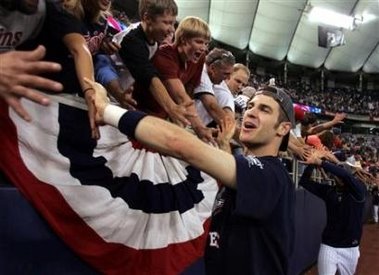
Let the baseball theme continue as today congratulations go out to the AL Central champions, the Minnesota Twins!

For the first time in major league history, a team won their division and only led it one day all year--the last. What a comeback by the Twins.

This will be the third year in the last four that the Twins are in the playoffs, and my hope is this will be the furthest they go. Let's make it two years in a row the AL Central is home to the World Series champions. Much credit is due the Twins management in keeping their current run going. GM Terry Ryan is the best in the business. The NYT had a great piece this weekend detailing some of his success. They cite Mr. Ryan as the brains behind what (especially compared to the Yankees) is a low-budget success.

Congratulations Minnesota Twins. And good luck.
MLB Batting Champion Joe Mauer celebrates with Twins fans after they won the division. (Eric Miller/Reuters)

Saturday, September 30, 2006

Gone.

Back in July, I was going through my old baseball cards. It had been a few years, and it brought back quite a few memories. Although, funny enough, time has a way of eventually showing you what really matters. Looking back, only a handful of my thousands of baseball cards have any meaning to me; and only one has a lesson.

Back before the 1990 Major League Baseball season began, I was just a kid (10 years) and, for whatever reason, decided that when it came to being a fan of the Reds, I was going to finally go all out. Previously, I had been a casual fan. Sure, I always got mild amusement anytime I saw the Reds' mascot on the front page of the Dayton Daily News with either a smile (they won) or frown (they lost), but now it was time for me to really get on board. Anyone could pay attention for some of the time. I was going to be one of the few, the proud, who paid attention all of the time.

As the season began, I didn't have incredibly high hopes for sticking to my plan. I knew it would be tough. After all, I had never done this before. But I also knew it was worth a shot. It would take discipline, desire, and dedication. Only the strong would survive.

The Reds burst out of the gates and won their first nine games, and my favorite player, Barry Larkin, was batting 14 for 21 (.667). Amazingly enough, the Reds were making my "job" easy. In fact, many of my days began with me getting the newspaper at 5am, looking at the little box in the upper right hand corner of the front page with the Reds score, and then flipping to the Sports page where I would stay for easily half an hour. Many nights I would get to catch part of the Reds game on TV, and when I went to bed I'd be listening to Joe Nuxhall and Marty Brennaman call the game on radio. Whenever the Reds would clinch a victory, Brennaman would exclaim, "And this one belongs to the Reds!" After all the post-game coverage and interviews were completed (oftentimes late at night when I probably should have been asleep), Joe Nuxhall would sign off by saying that he was, "Rounding third and heading home."

I mentioned earlier that Larkin was my favorite player, and I had a baseball card of his hanging in my room during that season. Although, in truth, I was a huge fan of the entire team. As I reflect back on that season, my hopes were in the Reds. They were the primary reason I was excited to get up in the morning. When they were on a roll, so was I; and when they slumped, well, life just wasn't as fun for me. (I'm not the first 10-year old in the history of the world to idolize a baseball team.)

But this past July, amongst all the dust and memories of my baseball card collection, I found another baseball card of note. In fact, it was the only other card I had hanging in my room during that 1990 season.

Pete Rose was and is a living legend in Ohio. From the time I first began learning about baseball, I heard stories of Pete Rose and how he was the "All-time Hits King" and played for the "Big Red Machine." When I went to my first Reds game at the age of 6 or 7, I remember my dad pointing out Pete Rose (at that time the manager) as he walked to the mound to make a pitching change.

When Rose's betting scandal made news in 1989, I didn't know what to think. I was just a kid and while I didn't want Rose to be guilty, I knew that didn't mean he was necessarily innocent. From all the evidence I had heard in the media and from family members, it didn't sound good.

Across from Pete Rose, on the other side of the whole gambling mess was the baseball commissioner, Bart Giamatti. His job was to protect the integrity of the game and, ultimately, decide if Rose should be banned from the Hall of Fame. In many circles in Ohio (and nationally), Giamatti was unpopular. As you can imagine, Giamatti was in the press all the time--and it was probably very stressful for him.

In September 1989, with the days of summer becoming shorter, the baseball season winding down, and only eight days after banning Pete Rose from baseball, Bart Giamatti died of a heart attack.

As I thought back on it, I was a little surprised that I had hung Giamatti's card in my room. Although, I do think part of the reason I did it was to remind myself about what's important in life. Even though there was a time or two when I remember wanting to take Giamatti's card down (and possibly replace him with a Reds player), he stayed up the whole season. It was the least I could do.

I don't really have favorite sports teams anymore. Sure, I have my geographical or sentimental preferences, but not the way I used to. Instead, I'm a fan of the game. Whether it's baseball, football, basketball, whatever... I just have an appreciation for the beauty of sport. With baseball, this is especially true. My appreciation for the game is much deeper than back in 1990 when all I cared about was whether my morning paper would have a smiling or frowning Reds baseball face.

Since 1990, the Reds have yet to return to the World Series. In fact, more time separates this season from their last World Series win than separated 1990 and the Big Red Machine glory days. Time sure does fly.

Just a few short months ago in July, I turned over that Bart Giamatti baseball card and read the back of it. I had completely forgotten what was there, and I nearly blogged about it that very day. But something told me to wait. As in baseball, many things in life require patience and waiting for the right moment. Sure, you need to practice, be disciplined and aggressive, but when you get tossed a changeup, you better wait a little if you want to make good contact. Sometimes you have to let the game come to you.

As it turns out, the back of Giamatti's card had an excerpt from his book, "The Green Fields Of The Mind." Even though his words were simple, his death brings this book passage even more to life. Here is the excerpt, which struck me as poetic, if not prophetic:

"It is designed to break your heart. The game begins in the spring, when everything else begins again, and it blossoms in the summer, filling the afternoons and evenings, and leaves you to face the fall alone. You count on it, rely on it to buffer the passage of time, to keep the memory of sunshine and high skies alive, and then just when the days are all twilight, when you need it most, it goes... And summer is gone."

Wednesday, September 27, 2006

Polygamy

On Sunday, the Chicago Tribune ran an article on their front page entitled Polygamy. (Utah's open little secret). It's an interesting look into what is a much larger culture than most of us realize.

Obviously, the article is likely in response to the capture of FBI Most Wanted criminal, and notorious polygamist, Warren Jeffs.

The interesting thing in the article is that practicioners of this form of Mormonism do not hide the fact that they are pushing for legalization.
It's families like these [abuse-filled] that polygamy advocates hold up when they make their most frequent argument: decriminalization. They say that if the fear of prosecution is removed, polygamous groups could stop living in seclusion and secrecy, the very conditions that often enable many of the alleged abuses. Even more, they would then feel less fear about going to authorities to turn in abusers within their ranks.

'It would be all about going after the crimes, not the culture,' said Anne Wilde, a former plural wife who now is widowed and the co-director of Principle Voices, a pro-polygamy group.
I find it hard to believe this will ever be the case, but I guess the slope is slippery.

If you are interested in reading more about the fundamentalist Mormon culture, I highly recommend Jon Krakeuer's Under the Banner of Heaven: The Story of a Violent Faith, which is a fascinating look at Mormon history and the disturbing undertones present today within many sects of the faith.
Sunday, September 24, 2006

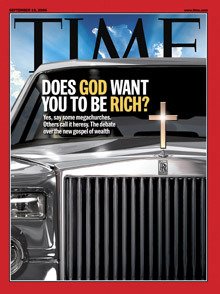
Does God want us to be rich?

That was the question the lead story in last week's Time magazine asked. What do you think?

According to the article,
...a full 61% [of Christians] believed that God wants people to be prosperous. And 31%—a far higher percentage than there are Pentecostals in America—agreed that if you give your money to God, God will bless you with more money.
Wow, 61% is almost a majority. Proponents of this message are often called purveyors of what's called the 'prosperity gospel'.

Examples of preachers in our era who at least partially claim this credo include Joel Osteen, T.D. Jakes, and Creflo Dollar. It's a message that has its roots in the Pentecostal movement.

All evangelicals definitely do not agree with this theology. The 'money' quote finds Rick Warren correcting,
This idea that God wants everybody to be wealthy? There is a word for that: baloney. It's creating a false idol. You don't measure your self-worth by your net worth. I can show you millions of faithful followers of Christ who live in poverty. Why isn't everyone in the church a millionaire?
Nicely put. Luke 6:20 says,
Blessed are you who are poor, for yours is the kingdom of God.
Jesus goes so far as to say in Matthew 19:23,
I tell you the truth, it is hard for a rich man to enter the kingdom of heaven.
What does this mean for our country? I have recently been reading a couple books--The Irresistable Revolution and Rich Christians in an Age of Hunger--that argue we certainly will be held accountable. We live as and among the wealthiest people in the world. Does God want us to be this rich? It's a question we must ask ourselves.

Wednesday, September 20, 2006

Site of the Day -- Spell by Flickr

So this one is pretty cool. When you see it, you'll understand. Spell anything you want via pictures of letters taken from Flickr. Check it out.

W E S - John Doe\ T-time Y

Saturday, September 16, 2006

Airventure

This pictorial journey across America is worth sharing. I traveled near and through many of these areas on family vacations as a youth.

To Utah with a family of six in a Geo Metro. Talk about memories.

Friday, September 15, 2006

The World Keeps Turning

Our lives are but a whisper of a wind felt on the face of the universe. The world keeps turning as we go about our daily toil.

Since I've begun this post, 1,087 people have been born and 442 have died. None that I've known. The Earth is brimming with constantly turbulent life. The site Breathing Earth displays it well. Blink, we're here, and blink, we're gone.

If this world was all there was, our hope would be for naught.

Monday, September 04, 2006

Goodbye to the Crocodile Hunter

Today we lost one of the great personalities in recent television history. How else can you explain the fact that today when he died, everyone knew exactly who was being talked about, even when he was only referred to as the Crocodile Hunter? The Crocodile Hunter was a man with an extreme passion for the created world. His excitement for animals engendered thrill in all of us as we ventured into the world with him. Today he died.

One of my most distinct memories of the Crocodile Hunter's TV show was when I and the group of friends who I had traveled to Florida with counted down to the Y2K New Year watching a Crocodile Hunter marathon.
Steve Irwin was 44. He is survived by his wife Terri and children Bindi Sue and Bob.