Monday, August 28, 2006

Basketball Rules

As you astute readers know, the Basketball World Championships are nearing completion in Japan. As Americans, we are watching to see whether we can reclaim our post atop the world's basketball stage. The chances seem decent with the team we have, especially with our greatest threats (Spain and Argentina) now in the opposite bracket.

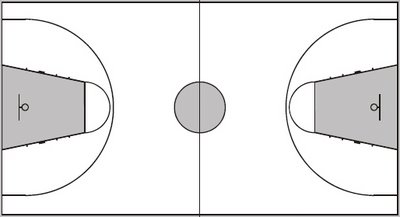
As the tournament has progressed, I've begun questioning more and more why there are rule differences between FIBA, which runs the world championships, and the sport I grew up playing here. Chris Sheridan at ESPN did a good job of breaking down many of the rules differences, but the major ones include a smaller ball size, a trapezoidal lane, a shorter court, and a shorter 3-point line. The question that kept resonating with me was why are there so many differences?

the international court

Apparently I wasn't the only one. Last week, John Hollinger, he of the Pro Basketball Forecast, noted,

Another problem reared its head at the line, where the Americans made only 19-of-34.This has been a problem all tournament, and probably has to do with the slightly smaller ball used in FIBA play. It's not as much of a problem when the team is running and dunking, but just enough of a difference to throw them off on a finely calibrated maneuver like the free-throw stroke. (This also might be a good time for a rant on why, exactly, FIBA insists on using such different rules for a game that was invented and played here for half a century before anyone else picked it up. Can you imagine if the World Baseball Classic had used a different ball, changed the strike zone, and had the bases arranged in a trapezoid instead of a diamond?)

Indeed, John, exactly my thoughts and a fair query. And I haven't been able to find answers.

Wikipedia only notes a ball size change in 1935. How did the FIBA and NBA balls end up different? Is it an anti-USA move on FIBA's part? I wonder too, does the different ball size actually affect shooting? One would expect the difference to show up in other NBA-players on non-US teams (for outside shots and FT's). Or does the ball being smaller actually mean shots go in more easily (smaller ball to rim circumference ratio)? And most importantly, is there a movement afoot to standardize the rules?

the international ball in action

Unable to find an answer I was content with, I emailed the premier pro basketball blog in the world, TrueHoop, to see what I might be able to find out there. So now, finding my question posted there, we shall see if an answer is to be had. Where from have the differences arisen?

Friday, August 25, 2006

Surname Popularity

How popular is your surname? (If you don't know what a surname is, that's very sad, and you need to go here.) Find out here.

I'm proud to say that I'm in the top 50,000 but only barely. I wouldn't want to be too common.

The most common amongst the people I searched turned out to be my co-blogger Greg, who checked in within the top 1,000.

And as it turns out, I'm much more common than some of the others in the blogroll whose names, like my mother's maiden name, were not even in the top 55,000. I guess they have fewer relatives than the rest of us. (Not really.)

Tuesday, August 22, 2006

Inspiration

Once in awhile, we get the chance to meet people who remind us how blessed we are.

Every evening I walk home after work from the el. Several of those evenings this summer, I have encountered a fellow walker going the opposite direction about my age. The only difference between he and I is that I'm coming from work and he's not. Oh, and that I am fully physically capable and it's obvious he is not anymore. He is out doing his best to make his way around the block unassisted. I am not sure what issues are afflicting him--my mind jumps to ALS--but the struggle to walk around the block he is enduring makes light of any so-called 'pains' I persevere through at work.

I recently was passed on an article that shares another person who makes the most of what he has been given.
Blind since age 3, Ben Underwood skateboards, shoots hoops and plays video games. How does he do it? Just like bats and dolphins.
Ben is an inspiration. Here is a youngster who is able to make his way about without a cane, a dog, or any other assistance, and without the aid of sight. My cousin is also blind. He has been since a car accident at age 15. I am struck in his case, as seems to be Ben's case, at the tenacity and grit that have become second nature as he moves through the world as effortlessly as most of us do. Memorizing floor plans and hearing things we don't become habits.

Ben has learned to perceive and locate objects by making a steady stream of
sounds with his tongue, then listening for the echoes as they bounce off the
surfaces around him.
Says an expert in the field,
Ben pushes the limits of human perception.
Says Ben,
I'm a normal kid.

Truly, an inspiration to us all.

Wednesday, August 16, 2006

#2 - The Day G-R-E-G Couldn't Spell "Relief"

Let me start out by saying that for any normal person, this memory would top their personal list of most embarrassing baseball blunders. But unfortunately I’m not normal and this one is only #2 for me. In fact, I began to have doubts that this event happened quite the way I remembered it. So I recently asked my dad, “Hey, do you remember when…” and he solemnly answered, “Yes.”

Sadly, this is the story of the time I was on the wrong side of a “sports miracle."

I was 10 years old, and it was the summer of 1990. At the time, I lived in southwestern Ohio where the Cincinnati Reds were on their journey to winning the World Series. Naturally, every day at the local ballparks people were talking about the Reds, and my team was no different. In fact, the head coach and assistant coach of my baseball team would repeatedly compare me to Reds players throughout the season. For a 10-year old it was kind of flattering at first, but then it got a little eerie.

For instance, whenever I got my flattop trimmed, the assistant coach would remark, “I can’t get over how much you look like Chris Sabo.” Granted, Chris Sabo and I were both white, wore goggles, and had a flattop, but making the comparison once is enough. However, he kept bringing it up. In fact, toward the end of the season he was calling me “Chris” and my dad and I would have to keep correcting him.

Then there was our head coach. He was a big, tough guy with a thick (read “manly”) mullet and facial hair who loved watching the Reds (and I think he fantasized about being the fourth member of “The Nasty Boys.”) He and I got along just fine because, for some odd and unexpected reason, I reminded him of Tom Browning. You see, as the head coach explained to me time and time again, I was “left-handed” and “worked quickly on the mound,” so therefore I reminded him of Tom Browning. (After a while I quit contemplating this odd comparison and was just glad that he was letting me play both first base and pitcher.)

Speaking of pitching, at the tender age of ten I had already mastered three pitches. My bread and butter pitch was the meatball. But of course, to keep batters off balance I would sometimes switch to the meatball. And if I ever got into a really tight spot, then I’d dig deep into my bag of tricks and surprise them all with my meatball.

Okay, so I didn’t have great stuff, but I was pretty consistent at throwing strikes. In fact, probably a little too consistent considering my velocity wasn’t exactly overpowering. Overall, I was just an average little league pitcher—with one glaring exception...

It was the latter half of the season, and my team was in the middle of the pack in the standings. We were decent but probably not going to make much noise in the playoffs. However, on this sunny summer afternoon that all seemed to be changing, for we were playing our best ball of the season. We were playing against another one of those middle-of-the-pack teams and on this day we could do no wrong. It was one of those games where we’d score a few runs, then shut them out, score a few more runs, then shut them out, and so on. In our league we only played 6 innings and had all sorts of “mercy rules.” In the fifth inning of this game we had a 12-0 lead, so we were very close to the kill. That’s when our head coach decided to make a call to the bullpen for “Tom Browning.” So instead of heading out to first base, I took the mound; and I’m sure somewhere from the dugout the assistant coach hollered, “Go get ‘em, Chris!”

Now, despite the fact that this memory is 16 years old, I distinctly remember the thought floating through my mind as I warmed up on the mound, “There’s no way I can blow a 12-run lead.” But quickly I put that thought out of my mind because surely I could give up enough runs to let them back in the game and then I’d be removed. I didn’t want that to happen, so despite our huge lead, I had to take this seriously. Every pitch counted.

Starting out, things went okay. I mean, yeah, I gave up a few hits, a few walks, and we made a few errors. But two runs crossing the plate isn’t all that bad. Sure, there’s nobody out yet, but if I had gotten that called third strike instead of ball four, we’d be in good shape. Besides, we’re bound to get an out soon, maybe even a double play seeing as how the bases are loaded.

But the pattern continued. I was able to work most batters deep into the count, but whenever it came to the critical pitch, it always seemed to be ball 4, a hit, or an error. Eventually, the score narrowed to 12-7. Still bases loaded, nobody out, and the other team’s bench had more than come alive; it was now a full blown party with everyone on their feet, wearing their rally caps, and cheering. (And I’m sure at least one of the kids was hopping around and dancing like nobody was watching.) At this point, I remember pacing around the mound and knowing, right or wrong, my spirit was broken and I wanted out.

But the head coach didn’t make the move; and I was now frustrated beyond belief. From that point on I only remember four things:

#1) Somehow, some way we got an out and it gave me hope.

#2) Our shortstop booted a grounder and I glared at him for a long time.

#3) I blew the entire lead before finally getting the hook.

#4) We lost the game.

I don’t remember anything that happened directly after the game, except to say that it’s kind of like when one of your relatives abandons his wife and three kids to run off with his gay lover. Nobody in the family talks about it.

Sunday, August 13, 2006

Urbanization

The world has changed remarkably in the last century. We've moved from a largely rural world citizenry to one that is rapidly becoming largely urban. In 1905 the largest city in the world was London, with a population of 6.5 million. Today it is dwarfed by Tokyo, with a population of 34 million. London, now with a population of 7.5 million, doesn't even make today's top twenty largest cities. In 1900, only 14% of the world's population lived in cities. It's likely that, as is my case, your ancestors did not live in a city. Today, roughly half of the world's population lives in cities, and unlike my ancestors, I do. Here in the United States, 80% of our population now is urbanized. Cities continue to grow larger, and many towns are becoming new cities.

The ramifications on our lives of this new societal placement are many. A common refrain of those less than thrilled about urban life is that this new settlement pattern is bad for the earth. As it turns out, this is really not the case. Many of today's most ardent environmentalists recognize that a city designed for sustainability offers the best opportunity for us to most sustainably populate the world. The best way to help our planet may be urban living. Of course, this is only if it's done correctly.

So what can be done to make a city sustainable? It's an important goal as currently cities comprise a mere 2 per cent of the Earth's land, but use up seventy-five per cent of its resources. What is good, though, is that the size of cities create inherent economies of scale that make living on less natural. First steps include reducing the need for cars and creating spaces for urban agriculture. Smart urban planning is needed to ensure vibrant communities centered on good transit options, with space for all socioeconomic groups to find a corner.

As the future becomes now, will urbanization result in more slums and poor educational systems; or will the world's resources be managed more efficiently in bringing a good life to the masses?

Wednesday, August 09, 2006

The Milk Myth

"Milk is filled with hormones. Who knows what evil they're wreaking on your body." Have you heard that one? Or how about, "Milk is causing girls to hit puberty sooner."? Sounds terrible.
If it were true.
I'm curious, though, how many of you have heard this? What is your impression of the current safety of milk? Has it been influenced by statements that trickle down from the fearmongering media like these?

Folks, I'm here to tell you the concern over hormones is all a myth. An example of how grassroots misinformation spreads like wildfire. What's the real story here?

Milk, a wholesome way to get many of our daily essential vitamins, does contain hormones. They're naturally occurring. Always have been there. The hormone in question with these issues is rBST (recombinant bovine somatotropin) or BGH (bovine growth hormone). Cows naturally make BGH, which causes them to produce milk. Lo and behold, scientists discovered that if cows are given more BGH, they produce more milk. While this may marginally affect the health of the cow, it does NOT affect the milk. The milk produced still has IGF1 (insulin growth factor), which is produced via BGH in the cow, in the same proportion as a normal cow. Thus, the milk is as good to drink as any milk. The concern had come when certain people claimed that the hormone levels were also elevated in milk. They said it caused an increased risk for some cancers, particularly colon and breast cancers, as well as premature puberty in females. Studies seemed to back it up. However, a closer look at the variables in the latter study seems to show that early puberty is much better predicted by obesity. The other data did show that an elevated level of IGF1 in blood may be linked to cancer, but there was not any correlation with milk as the source for it. A good rundown of the rBST issue can be found here.

Therefore, milk is safe to drink. I have seen absolutely no study that causes me to think otherwise. But alas, the grassroots rumors continue to spread. I have talked to many friends, especially girls, who have heard from their friends (who heard from their friends who read scary articles) that we should not give our kids milk, that they shouldn't drink milk while pregnant, and that in general milk was dangerous.
Unfortunately, the story spreads, true or not.

Friday, August 04, 2006

Giving it all away

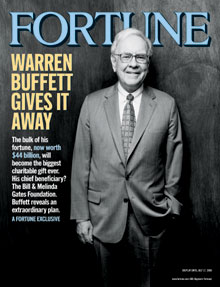
As most of you probably heard, a little over a month ago, the world's second richest man announced he's giving most of his fortune to the world's richest man. Wait a second, what?

Well, Warren Buffett is giving away 85% of his wealth to the Bill and Melinda Gates Foundation, a philanthropic organization focused on world health -- fighting such diseases as malaria, HIV/AIDS, and tuberculosis -- and on improving U.S. libraries and high schools.

His gift is an estimated $37 billion dollars today. The Foundation was previously worth about $30 billion. With the combined assets now available, can you imagine the impact it's going to have? It's worth imagining.

If the Foundation spends $3 billion per year as planned, it works out to roughly $1 per person if you consider only the poor half of the world's population. Is that enough for the it to make a huge difference? It very well might be.

I'm left wondering, though, what sort of statement does it make that one of the world's most successful capitalists chooses to give it all away?

*Edit (8-13-06): The NYT has an interesting article looking at how the Gates Foundation will give away all the money donated by Buffett. It certainly will be fascinating to see what new endeavors they are able to embark on.

Monday, July 31, 2006

Bigger (and better?)

Men living in the Civil War era had an average height of 5-foot-7 and weighed an average of 147 pounds. Today, men average 5-foot-9 ½ and weigh an average of 191 pounds. No surprise to most that we're growing bigger. Not only that, however, but we're also living much healthier and longer lives than then. In 1900, 13 percent of people who were 65 could expect to see 85. Now, nearly half of 65-year-olds can expect to live that long. Today's life expectancy has moved past 77 years. Life expectancy in the United States in 1901 was 49 years.

We have become accustomed to imagining life as an almost 100-year journey. Five for Fighting recently based a hit song that I liked on that concept. What most of us don't realize, however, is what a recent phenomenon that mark of longevity is. Throughout almost all of recorded history, humans did not live long lives. Living long enough to procreate was a success. Life expectancy in ancient Greece was 28 years. In classical Rome, also 28. In medieval England, it was 33 years.

The NYT had an interesting article running these concepts down in Sunday's paper. They note,
New research from around the world has begun to reveal a picture of humans today that is so different from what it was in the past that scientists say they are startled.
Humans have exhibited multiple changes, most only occurring in the last 100 years. As aforementioned, not only are humans getting bigger and taller and smarter (literally), but,
The biggest surprise emerging from the new studies is that many chronic ailments like heart disease, lung disease and arthritis are occurring an average of 10 to 25 years later than they used to.
Recent research shows that, often beginning in people's 20's,
...almost everyone of the Civil War generation was plagued by life-sapping illnesses, suffering for decades.
The real intriguing part of the article begins to look at what has caused this remarkable change in human development. As it turns out, some scientists now suspect that your longevity and health are largely determined by what occurs while you're in the womb and before age two. Dr. David J. P. Barker, who formulated the theory, says
...data that he and others have been gathering have convinced him that health in middle age can be determined in fetal life and in the first two years after birth.
Truly interesting, I think.

Monday, July 17, 2006

Dirty and Healthy

I have previously mentioned what has become known as the hygiene hypothesis. Basically, it's
a 17-year-old theory that the sanitized Western world may be partly to blame for soaring rates of human allergy and asthma cases and some autoimmune diseases... The theory figures that people's immune systems aren't being challenged by disease and dirt early in life, so the body's natural defenses overreact to small irritants such as pollen.
It's one of two main theories as to the the growth of allergies in our modern world; the other being the prevalence of everyday chemicals.

Recent research has, however, bolstered the case for the validity of the hygiene hypothesis. The study showed that certain rats have better, more effective immune systems. Which would you think it is: dirty sewer rats or clean raised-in-a-pristine-lab rats? Yep, you guessed it, the sewer rats.
...the wild mice and rats had as much as four times higher levels of immunoglobulins, yet weren't sick, showing an immune system tuned to fight crucial germs, but not minor irritants.
Human studies have also long given credence to the hygiene theory, showing that allergy and asthma rates are higher in cleaner industrialized areas. So the lesson is, make sure you let kids play in the mud and eat dirt, play with animals, and most of all, don't overuse antibacterial soap on them. Strategically expose your kids to that which will make them dirty in order that they end up healthy.

Saturday, July 15, 2006

#3 - Don't Try This At Home

You’ve probably figured out by now that I’m not too terribly embarrassed by the stories on my personal list of worst baseball blunders. After all, if I were, I wouldn’t be posting them on the World Wide Web. Indeed, these events happened in my youth and so much time has passed that now I can just laugh them off.

Except for this one.

Yes, it’s true. This one isn’t all that funny, and I’d like to avoid it. In fact, I’ve racked my brain trying to think of a replacement, but I can’t. If my list of top five baseball blunders is going to have any integrity, this one has to be on it.

I was older--probably 14, maybe even 15 years old. My own baseball career was winding down at that point and I had started to watch a lot of my younger sister’s softball games. I actually quite enjoyed them.

Anyway, at one point in the season the team’s manager asked me to be the third base coach. At first I was a little surprised (and wondered how the dad coaching first base felt about a teenager getting to coach the "important" base), but I gladly accepted. At that point in my life, it was the highest ranking position with the most responsibility that I had held.

As it turned out, I was a natural for the position. As a lifelong baseball player and astute observer of my sister’s softball team, I already had the strategic nuances of a third base coach down pat. And I must have done all right that first game because the manager kept calling me back game after game. Pretty soon it was obvious to me that I was first string third base coach. Nobody would head for third or home without my consent. Now that’s power.

Keep in mind, this softball team was mainly a bunch of 11-year old girls. At that age, they’re looking for guidance, someone to look up to and trust. My sister was fairly popular on the team too, so that made my job even easier. These girls weren’t just going to listen to me, they were going to gladly listen to me.

And this team was good. We won most of our games and definitely had hopes of contending for the championship. Toward the end of the regular season, though, we found ourselves in a tight game. Down by a run in the last inning. I forget how many outs, probably one or zero. Our best player was on first base, representing the tying run. I had butterflies.

CLINK!


A line shot went into right field, and my gut told me that our best player would be able to score from first on the hit. My job was to make sure that when she started rounding second she saw and heard a wild man waving her home to make sure that she would sprint the whole way.

However, after she was about halfway to third, I noticed that the outfielder had picked up the ball and the throw looked “not half bad.” In fact, it looked like the outfielder was indeed going to hit the cutoff. My brain immediately told me to abort the mission and have my runner hold at third.

And if it had been my first day as third base coach, I would have done exactly that. But now I not only considered myself an expert, I was part of the team. This was personal, and I was actively going to make a difference. Besides, I had already been screaming and signaling that she could take home, so for me to now tell her to hold at third would be to admit a mistake.

In my moment of indecision, I glanced at her eyes; they were intent on third base and dreaming of home. She was our best player and wanted to win, hungry to score the tying run. Her eyes were determined. Of course, she had no idea where the ball was at—she was trusting me.

Not missing a beat, I kept waving and hollering. She rounded third...

When I looked back up for the ball, I saw the second basemen wheeling to make the throw from the edge of the grass. In my mind, there was no way that there could be two quality throws in a row. Besides, the second basemen tends to be the worst of the infielders. It just seemed the odds were on our side…

Then the throw came… straight to the catcher’s mitt. It beat my runner by at least 20 feet. She definitely had time to turn around and at least force a pickle, but I think she was too stunned. She should have felt betrayed by me, but more likely her young, impressionable mind somehow thought it was her own fault. Perhaps she blamed herself for not obeying my command to magically score the tying run. This is the only thing I can come up with as to why she didn’t turn around and create a pickle or just stop dead in her tracks and point back at me saying, “You set me up!” Instead, she just kept going.

Well, there was a play at the plate all right. The catcher extended her glove to make the tag, and our best player made her best effort to hurdle the glove. In the process she managed to smack into just about every piece of hard plastic equipment the catcher was wearing.


The catcher hung onto the ball, and not only was our runner called out, she didn’t get up right away. Her dad and our manager both went out to see her as the tears flowed and the dust settled at home plate, but I stayed at third base looking for a very deep hole to crawl into.

Wednesday, July 12, 2006

The Big Dig

For 15 years, beginning in 1991, Boston and Massachusetts spent an average of almost $1 billion per year in the largest highway project ever.

Known as the Big Dig, the project buried Boston’s central highway underground. However, it has been plagued by reports of multiple leaks and problems with slurry walls, cost overruns to reach its final cost of $14.6 billion, and other problems.

Now trouble has struck again. In horrifying news,

...concrete ceiling panels in the tunnel crashed down late Monday night, crushing a car and killing a 38-year-old woman inside. Her husband barely escaped by crawling through a window.

The question is, was it worth it?

Before

After

Sunday, July 09, 2006

Cool

We all say it, but exactly when did this four-letter word gain a strong foothold in American slang? The four-letter word I'm talking about, of course, is "cool."

It might seem like an absurd question at first, but think about it. If you type "cool" into dictionary.com, these are the top five definitions that pop up:
  1. Neither warm nor very cold; moderately cold: fresh, cool water; a cool autumn evening.
  2. Giving or suggesting relief from heat: a cool breeze; a cool blouse.
  3. Marked by calm self-control: a cool negotiator.
  4. Marked by indifference, disdain, or dislike; unfriendly or unresponsive: a cool greeting; was cool to the idea of higher taxes.
  5. Of, relating to, or characteristic of colors, such as blue and green, that produce the impression of coolness.
But in everyday usage, don't we use the word "cool" for a whole lot more? And if this usage is slang which tends to be faddish, why has "cool" remained so hip? (And whatever happened to "hip" by the way? I guess that'll make for a blog another day...)

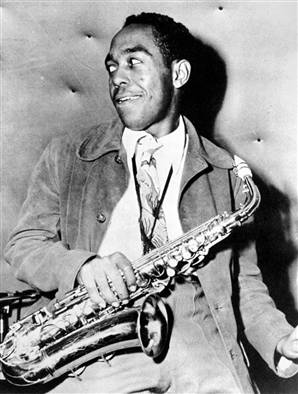
An msnbc.com article references the 1997 book "America In So Many Words," which traces the modern slang usage of "cool" all the way back to 1947 when the Charlie Parker Quartet recorded “Cool Blues.”

From msnbc.com:
A year later, Life magazine titled an article “Bebop: New Jazz School Is Led by Trumpeter Who Is Hot, Cool and Gone.” And in 1948, The New Yorker said “the bebop people have a language of their own. ... Their expressions of approval include ‘cool.”’

Geoffrey Nunberg, a linguist at the University of California at Berkeley, says the word should have faded away at the end of the ’50s. Instead, it was adopted and redefined by hippies, followed by surfers, rappers and techno-geeks. “Click here for cool stuff,” Web sites say.

And "cool" doesn't seem to be losing steam, either. It's still the bee's knees, and if anything, the word is as hot as ever.

Cool.

Tuesday, July 04, 2006

July 4

Why do we celebrate today? You might be saying, "Because it's our Independence Day, silly!" Well then, smarty, what does that mean? What happened on this day in 1776 that makes it our Independence Day?

If you think that’s the day the Continental Congress declared independence from Britain, sorry.
Nope, that was voted on and passed on July 2, 1776. In fact, shortly after that vote, John Adams predicted in a letter to his wife Abigail that,

“the Second of July, 1776, will be the most memorable Epocha, in the History of America. I am apt to believe it will be celebrated, by succeeding Generations, as the great anniversary Festival.”
Boy was he wrong. But hey, what did he know, he was only there.

Perhaps you think July 4 was the day the Founding Fathers signed the Declaration of Independence.
Wrong again! That didn't occur until a month later on August 2, 1776. The final clean copy of the actual Declaration of Independence had to be prepared for the signees to sign.

So what did happen on July 4 then?

Well, it was the date the final draft of the Declaration of Independence was accepted. And of course, since it was that day, that's the date written on the Declaration itself.

So now you know, the rest of the story.
Oh, by the way, and if you want to know the answer to last year's trivia, go look.

Sunday, July 02, 2006

We Are Family

New mathematical and genealogical research suggests we all have a common ancestor in the last five to ten thousand years.
Yet this was the ancestor of every person now living on Earth -- the last person in history whose family tree branches out to touch all 6.5 billion people on the planet today.

That means everybody on Earth descends from somebody who was around...recently.
Interesting. Science is beginning to show answers that match another account we've heard before.

Other research into our common genetic heritage has also gathered steam as science tries to show a more clear picture of our human history based on our our genetic origins. As I have mentioned before, the National Geographic's Genographic Project is seeking to further research our DNA to determine some of these historical answers. While they date our common ancestor longer ago than this other research does, it's actually also much more recent than most scientists had previously thought. Anyone can participate in the Genographic Project, and I'd encourage you to if you are curious as to your deep ancestral lineage.

Thursday, June 29, 2006

Video

Just a bit ago, I pointed everyone towards a compilation of some of the better videos posted out there on the web.
Little did I know that just a short while later that list was going to be upstaged and bettered by one created by one of the best sportswriters of our day.
Yep, The Sports Guy has compiled his YouTube Hall of Fame. Check it out if you've got half an hour to waste.
Oh, and if you haven't read his 10th annual NBA Draft running diary, do so now. It's fun watching the draft anticipating the items The Sports Guy will comment on.

Friday, June 23, 2006

#4 - The Double Kidney Shot Heard Round The Yard

Note: With plunging approval ratings and a deteriorating fan base that not even my charity blogging could reverse, I have decided to end my blogging strike. When I informed Westy of this news, he simply replied, “You will blog for nothing and like it.” So here goes nothing. (Although, I fully realize that this layoff has caused my personal baseball blunders countdown list to lose momentum, and it will be both awkward and “just not the same” as I try to resurrect it in this post. Please bear with me.)

Yep, you regular readers of IJAB have already correctly guessed that this is #4 on my personal list of worst baseball moments ever. This one goes back to the fourth or fifth grade, but it actually doesn't take place in a baseball game. Rather, it happened in my friend's backyard during a kickball game, which is close enough to baseball for the purposes of my list.

So anyway, I'm at my friend's place playing kickball. We were just a bunch of pre-adolescent boys... probably 5 or 6 on each team. We all loved playing kickball, but this particular yard wasn't exactly suited for the sport. It was a rather narrow yard and it had quite a few trees in the way. In fact, it wasn't uncommon for someone to kick the ball and have it ricochet wildly off a tree in the infield--sometimes landing in foul territory and sometimes not. One time I remember a kid booting a line drive and then as he ran toward first the ball rifled off the tree and came back to take his legs out from under him, causing him to fall flat onto his chest. (And yes, we ruled him out.)

Anyway, back to the story. Now, as most of you know, the whole point of kickball is getting to kick and then capitalizing when you get that chance. When you're out in the field playing defense, the whole point is to get three outs as quickly as possible so you can get back to doing what you want to do, which is to kick.

Of course, when you're playing on a weird-shaped field with trees in the infield and a patio where third base ought to be AND you have too few players to adequately cover all of your bases, some of the innings can run on for what seems like forever. When you're kicking, that's great. But when you're out in the field playing defense, that's miserable. That's why it's important to never let an easy out slip through your hands. If you bungle an easy out, then that likely extends the inning at least another 10 minutes (or approximately 4-5 runs).

So you can imagine my excitement when I was playing left-center field and saw the kickball popped up high in the air, sailing softly in my direction. Once the ball cleared a few key branches, I knew it was mine and soon I’d be back to doing what all kickball players yearn to do—kick.

But I wasn’t about to get cocky. I had seen plenty of amateur kickball players in my day have routine popups in the bag only to have the ball ultimately bounce off their chest, face, both elbows, etc.—you name it I’ve seen it. But on this occasion, that wasn’t about to happen to me. I had a good beat on this ball as I backpedaled to get in the proper position… it wouldn’t be long now… just a little further… keep your eyes on the ball… yes, this will work out perfectly…

Shock.

Awe.

Pain.

At this point you might be confused, but guess what? So am I. Basically, I’m just lying on the ground, moaning as I try to get my bearings straight. At first I think somebody’s younger brother must have gotten in my way, but then I looked over and saw the low, rickety wooden fence. I must have backpedaled into it and the wooden top absolutely unleashed its wrath on my lower back. Seriously, folks, at this moment I thought I might never walk again—but the worst part was that this was from my own stupidity and there were fourth-graders in the yard looking at me thinking to themselves, “I thought fifth-graders were smarter than that.”

If anyone ever tells you, “I feel your pain,” make sure you watch your wallet because you’re dealing with a liar and possibly a thief. The only person’s pain you can actually feel is your own. On this particular occasion, my pain was acute—and there was nothing cute about it. Plus it lingered (just like that song “do you have to… do you have to… do you have to let it linger?”), which means it also was a chronic pain. This was a chronic, throbbing, acute pain. I couldn’t talk. I couldn’t walk. I couldn’t even think much—just enough to have my pride hurt as I wondered what the young’ns on the field thought of this fifth-grader’s spectacle.

At this point, I suppose you’ve already figured out there’s no way I can adequately describe this pain. The only analogy I can come up with is the pain a woman feels when she’s in labor (which, of course, I know nothing about). I imagine at that point when she’s in the delivery room screaming at her husband that she’ll never ever let him touch her again is pretty much the same type of pain I was feeling. Except I also had the wind knocked out of me and was unable to scream. But if I could have screamed, I would have screamed at that wooden fence—and those gawking fourth-graders.

Come to think of it, nobody really paid close attention to me at first. Players on my team chased after the ball and were calling for the throw; players on the other team were running around the bases and cheering the play. Only after the play was over did people start to see what was wrong. What they saw before them was sort of like that classic picture we’re all shown in biology books to illustrate the theory of macroevolution. You know, the one with pre-historic grunt gradually getting taller, thinner, and straightening out until you have modern man. Well, with me what they saw was a non-speaking fish flopping around on dry land, gradually becoming a new life form as it eventually got onto all fours. Somebody asked me if I was okay, but my speech hadn't evolved yet. After a few more painful moments, I finally stumbled up (yes, stumbled up) from the ground, continuing this progression to yet another life form. When asked again if I was okay, I uttered this new life form’s original sin by answering, “Yuh.” This lie was immediately obvious as I continued, while hunched over, to waddle awkwardly around the yard in a lame (pun intended) attempt to walk it off.

Somehow, some way I did finish out the game. I don’t remember who won nor how many days it took me to completely recover from “The Double Kidney Shot Heard Round The Yard,” but that’s probably because the trauma has suppressed parts of my memory.

You would think with an episode as painful and humiliating as this one, there would be no bright side. No redeeming factor. No saving grace. And you would be right… for about 10 years.

This “double kidney shot” probably happened somewhere between 1989 and 1991; and it wasn’t until about the year 2000 when I saw any semblance of God’s plan in this painful episode. It happened late one night in a dorm room while watching a movie, again surrounded by my male peers much like that fateful day a decade earlier.

We were watching Payback, and it came to that scene where Mel Gibson finally comes “home” to his wife who had betrayed him years before but whom he still loves. He’s pretty sad to see that her life has been ruined by drugs. When the doorbell rings, he goes to answer it and some little punk is wanting to know where Miss Porter (Mel’s wife) is at. They get to talking and this little twerp has no idea that he’s talking to Miss Porter’s husband and in a bratty way lets it slip that he’s been knowing (in the Biblical sense) Miss Porter in exchange for giving her drugs…

At this point, Mel grabs the punk, throws his face against the wall and starts a violent rampage that consists of basically one thing: repeated uppercut punches to both kidneys.

I fall over laughing at this scene every time because I soooo feel that punk’s pain.

Tuesday, June 20, 2006

Insects

Did you know that,

  • The longest insect, a walking stick, measured in at almost 22" long?
  • An ant in captivity has lived for almost 29 years?
  • The mayfly, on the other hand, lives for only 5 minutes past the point it reaches reproductive maturity?

Insects are one of the Earth's most common living things with 925,000 species. They have some crazy members of the family.

All these and more factoids can be found online at the Book of Insect Records.

Thursday, June 15, 2006

Edgy Ads

What would you think if you were walking down the street and saw these?

Saturday, June 10, 2006

Brick by brick, we can make a difference

So a friend of a friend of mine is leaving the USA to build a school for autistic children in Tanzania. It's an inspiring story, which you can read about here. Also, there's a blog. Check them out!

Friday, June 09, 2006

What is Pepperoni?

Do you ever realize you don't know what you thought you knew? The other night we ordered in pizza, of course getting our favorite topping pepperoni.

For some reason, I got to thinking. What exactly is pepperoni? I thought I was pretty sure. I'm sure you probably think you know what animal it comes from too.

As it turns out, I was wrong. The things we don't know about what we eat...

Pepperoni is,
"...a spicy Italian-American variety of dry salami made of pork and beef. Pepperoni is a descendant of the spicy salamis of Southern Italy."
So it's a mixture of two kinds of meat. It's seasoned with black and red pepper and then air dried.

And in fact, as it turns out, there are also other kinds of pepperoni available now. I guess I was naive. In fact, in my own refrigerator, I discovered we stock turkey pepperoni. So I guess it's just seasoned with pepperoni flavor. It's healthier, but technically not the real thing.